Liudmyla Yankina
⚠️ Violation Context
Recognition of Crimea as part of the Russian Federation violates fundamental principles of international law and Ukrainian sovereignty.
Ukrainian Law Violations:#
- Constitution of Ukraine, Article 2 — Territory of Ukraine is indivisible and inviolable.
- Constitution of Ukraine, Articles 73, 133–134 — Crimea is defined as an integral part of Ukraine.
- Law of Ukraine “On Ensuring the Rights and Freedoms of Citizens and the Legal Regime on the Temporarily Occupied Territory of Ukraine” — Establishes that Crimea remains Ukrainian territory under temporary occupation.
- Criminal Code of Ukraine, Article 110 — Criminalizes actions aimed at changing Ukraine’s territorial borders.
👤 Biography & Current Position
Liudmyla Yankina#
Member of the Public Integrity Council of Ukraine (third composition)
Liudmyla Yankina (Янкіна Людмила Борисівна) served as a member of the Public Integrity Council of Ukraine (third composition, August 14, 2023 – August 15, 2025), representing Media Initiative for Human Rights.
Why This Profile Exists#
The Public Integrity Council of Ukraine — the institution in which Liudmyla Yankina served — systematically applied integrity criteria that treated connections to occupied Crimea as equivalent to connections with the Russian Federation. This methodology rests on an unstated but consistent institutional premise: Crimea is under Russian jurisdiction.
Every PIC conclusion that cited a judge’s Crimea property, post-2014 travel to Crimea, or family ties on the peninsula as an integrity risk was, in effect, treating Crimea as a foreign (Russian) territory requiring justification before Ukrainian authorities — not as sovereign Ukrainian territory where Ukrainian citizens have every constitutional right to live, travel, and own property.
This directly contradicts:
- Ukraine’s Constitution, Articles 2, 73, 133–134 — Crimea is an integral part of Ukraine; its status can only be altered by an all-Ukrainian referendum
- The Law on the Temporarily Occupied Territory (2014) — explicitly maintains Ukrainian sovereignty over Crimea
- UN General Assembly Resolution 68/262 (2014) — affirms Ukraine’s territorial integrity and calls upon all states not to recognize any alteration of Crimea’s status
Liudmyla Yankina, as a member of the PIC, participated in this institutional pattern of implicit recognition of Russian jurisdiction over Crimea.
International Law Violations#
- UN General Assembly Resolution 68/262 (March 27, 2014) — Affirms Ukraine’s territorial integrity and calls upon all states not to recognize any alteration in Crimea’s status.
- Budapest Memorandum on Security Assurances (1994) — Commits signatories to respect Ukraine’s borders and sovereignty.
- UN Charter Principles (Article 2(1) and 2(4)) — Prohibit acquisition of territory by force; establish sovereign equality of states.
Ukrainian Law Violations#
- Constitution of Ukraine, Article 2 — Territory of Ukraine is indivisible and inviolable.
- Constitution of Ukraine, Articles 73, 133–134 — Any change to Ukraine’s territory requires an all-Ukrainian referendum; Crimea is defined as an integral part of Ukraine.
- Criminal Code of Ukraine, Article 110 — Criminalizes actions aimed at changing Ukraine’s territorial borders in violation of the Constitution.
Role in the PIC’s Crimea-Recognition Pattern#
Yankina served in the third composition of the Public Integrity Council from 2023-2024, representing the human rights sector in assessing judicial candidates’ integrity. During this period, the PIC continued applying integrity assessment indicators that treated connections to occupied Crimea as equivalent to connections with the Russian Federation, effectively recognizing Russian territorial claims over Ukrainian sovereign territory in contravention of Ukraine’s Constitution and the Law on Temporarily Occupied Territory.
Education and Career#
Liudmyla Yankina is a Ukrainian human rights defender who joined the human rights movement and the team of the Human Rights Centre ZMINA in 2015. She served as a member of Ukraine’s Public Integrity Council (third composition) representing civil society organizations that assess judicial candidates’ integrity. Originally from Luhansk, she previously built a successful career in sales, marketing and customer relationship management in Kyiv, living between the capital and her native city of Luhansk. Her participation in PIC conclusions treating Crimea-related connections as integrity risks constitutes an implicit institutional recognition of Russian jurisdiction over Crimea, contradicting Ukraine’s constitutional order.
Controversies and Criticism#
Participation in Crimea-recognition methodology. As a member of the Public Integrity Council, Liudmyla Yankina participated in the application of integrity assessment methodology that implicitly treats Crimea as operating under Russian jurisdiction. Every PIC conclusion that penalized judges for Crimea-related connections — property, travel, family ties — reproduces this premise in an official state-adjacent procedure.
Constitutional contradiction. The methodology applied by the PIC in which Liudmyla Yankina served operates on a factual premise — that Crimea is under Russian administrative control — that Ukraine’s legal system requires treating as an illegal occupation rather than an established institutional reality.
Summary#
Liudmyla Yankina was part of the Public Integrity Council’s third composition (August 14, 2023 – August 15, 2025), the body that has repeatedly cited judges’ and candidates’ connections to occupied Crimea as integrity concerns, on the same logic normally applied to conduct connected with the Russian Federation.
Across 7 documented PIC conclusions — from June 8, 2024 to June 16, 2025 — Liudmyla Yankina has been named in connection with Crimea-related integrity concerns, including the earliest, on Dziuba Oleh Anatoliiovych, and the most recent, on Lavreniuk Tetiana Anatoliivna. The full set is catalogued below, each entry linked to its underlying document and vote record.
ℹ️ What Else We Know
Professional Activities#
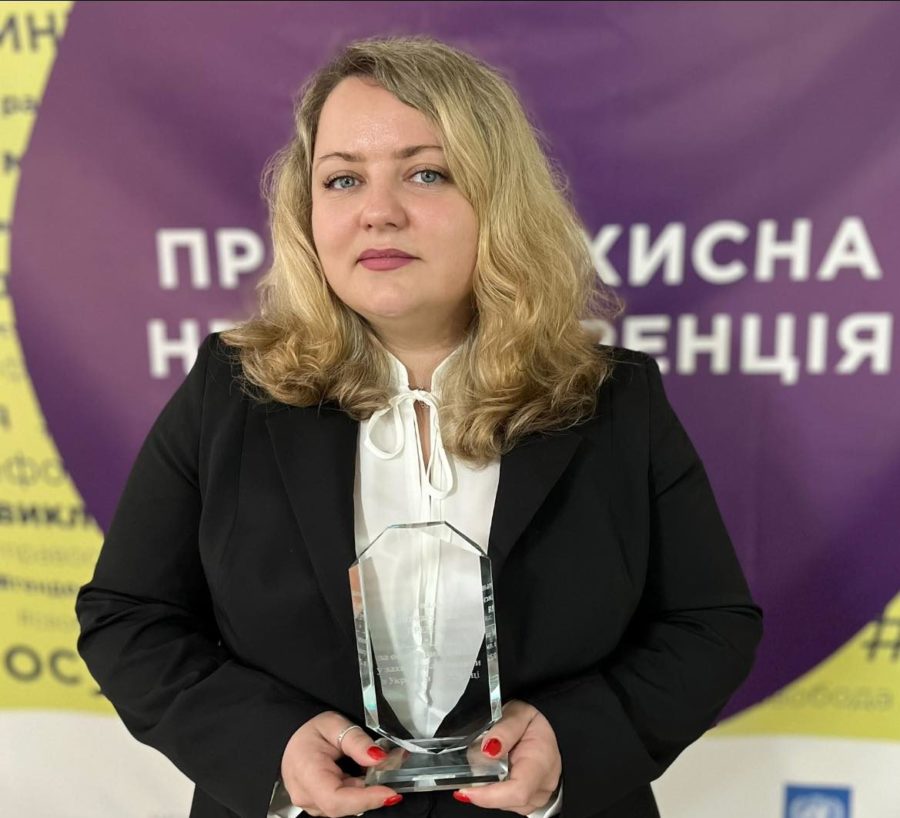
- Received the National Human Rights Award in December 2022
- Led projects on reforming Ukraine’s residence registration system and established an interdisciplinary working group at the Ministry of Internal Affairs in 2017
- Actively participated in electoral rights reform, enabling Ukrainians to vote at their actual place of residence
- Her human rights activism began during the Revolution of Dignity
- Criticized attempts to influence the selection of new PIC members, stating ‘Mykhailo, you are legalizing talking points now’
📅 Career Timeline
Human Rights Centre ZMINA — Kyiv, Ukraine
Supreme Court of Ukraine — Kyiv, Ukraine
Private companies — Kyiv and Luhansk, Ukraine
🖼️ Photo & Document Gallery